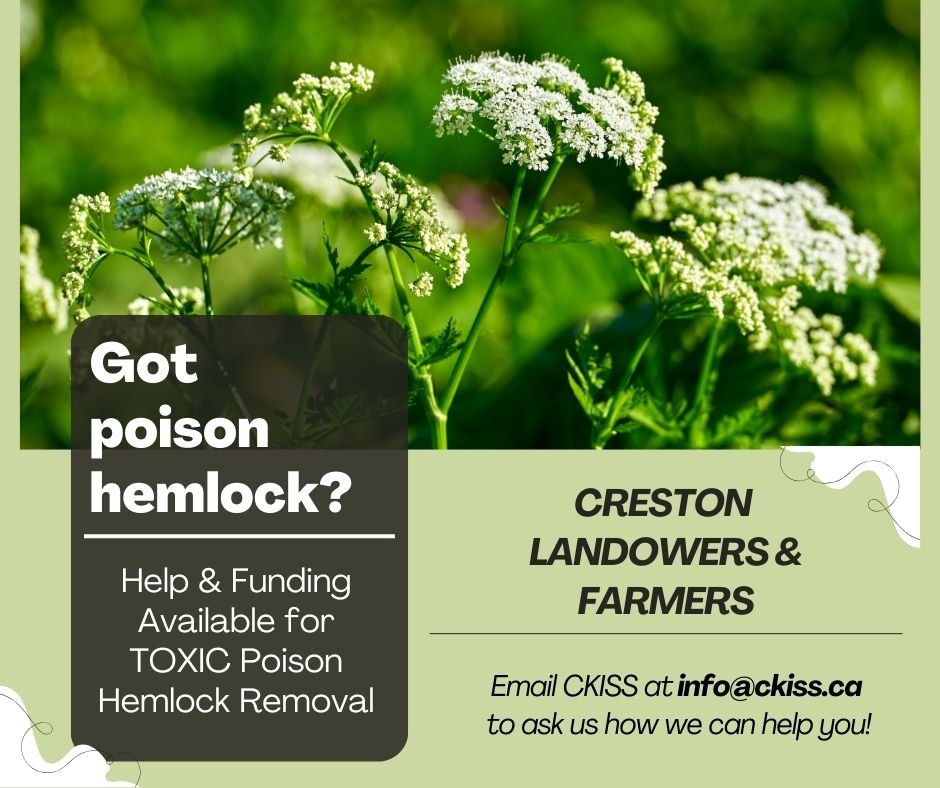
The Central Kootenay Invasive Species Society (CKISS) is asking private landowners, farmers, and residents in the Creston area to report poison hemlock on their properties and learn how CKISS can help remove this highly toxic invasive plant including financial assistance and volunteer support.
CKISS is coordinating a community-based Poison Hemlock Program for spring 2026 and can support private landowners in several ways, including guidance, trained volunteer assistance, and financial incentives for treatment.
CKISS is asking private landowners and members of the general public to report poison hemlock wherever it is seen in the Creston area. Landowners who would like CKISS support with management are encouraged to include that information when contacting CKISS. Early reporting is critical to support planning for the spring 2026 treatment season, and even brief location details are helpful. If you have seen poison hemlock on your property or elsewhere in the Creston area, please report it by calling 1-844-352-1160 or emailing info@ckiss.ca
Why should I be concerned if this plant is in my community?
Poison hemlock (Conium maculatum) is a highly toxic invasive plant that poses serious health. All parts of the plant are deadly to people, livestock, and wildlife when ingested. The plant should never be handled without proper personal protective equipment, including gloves, eye protection, and long sleeves. Community members are urged to follow all safety guidelines before participating in any removal activities.
Residents who are unsure whether a plant is poison hemlock can visit CKISS’s plant profile to learn how to identify it and understand the risks.
Reporting Poison Hemlock: Why Direct Contact Matters
CKISS recommends tools such as iNaturalist to help identify plants and contribute to citizen science by uploading photos that show where invasive species are located. These observations help build broader awareness and mapping of poison hemlock in the region.
However, direct reporting to CKISS is essential to ensure a timely response and action. Reports sent directly to CKISS allow staff to confirm identifications, coordinate next steps, and determine where support, resources, or volunteer assistance may be available.
Volunteers Welcome — Training, PPE, and Cash Incentives Available
CKISS is also welcoming volunteers interested in learning how to safely treat poison hemlock as part of this program. CKISS can provide, personal protective equipment (PPE), training in safe mechanical treatment and cash rewards for completing approved treatment work
What do we want to accomplish?
CKISS’s goals are to eradicate poison hemlock from the Creston area, assist private landowners with safe and effective management, and build long-term community capacity to address this toxic plant. A key part of this approach is connecting private landowners who do not have the capacity to treat poison hemlock themselves with trained volunteers who are seeking hands-on experience, training, and a financial reward. Landowners may also choose to conduct mechanical treatment on their own property and receive cash incentives, or recruit someone they know to be trained by CKISS and collect the rewards.
Increasing awareness of poison hemlock, training local volunteers, and expanding community involvement are central goals of the program, helping ensure this dangerous plant is identified, managed, and reduced across the Creston area.
Thank you!
The CKISS recognizes the Habitat Conservation Trust Foundation for making a significant financial contribution to support the Poison Hemlock Patrol. Partnerships are key to conserving BC’s wildlife, fish, and their habitats. Additional support has been provided by Columbia Basin Trust and the Province of B.C. Thank you for your support!