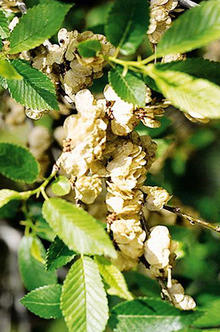
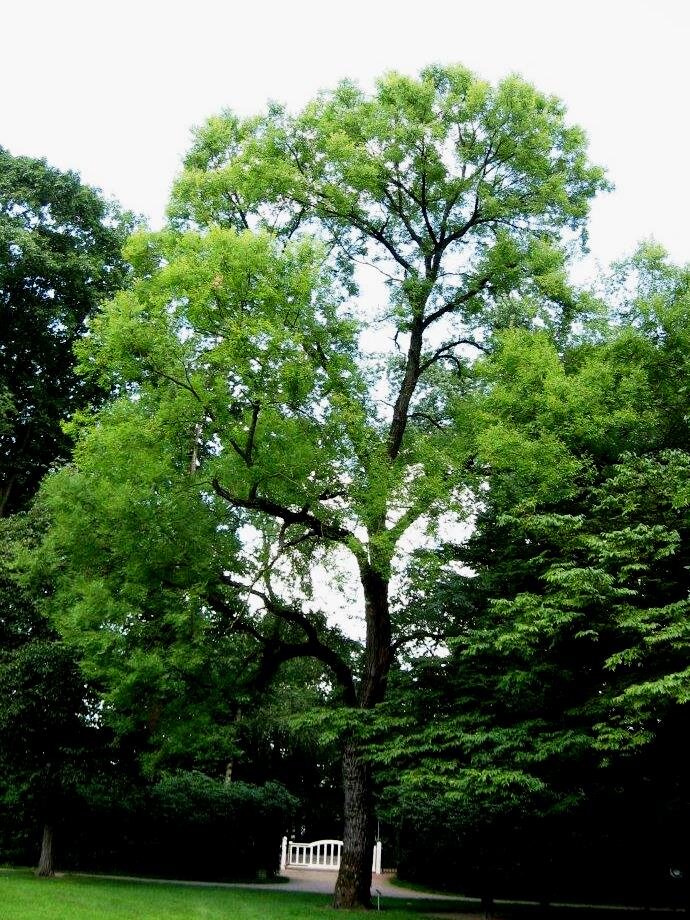
Ulmus pumila
Description
- Deciduous tree with a rounded crown
- Grows 9-21 m (30-70’) tall
- Bark is gray/brown and shallowly furrowed when mature
- Twigs are zig-zagged in shape with a leaf bud at each bend
- Leaves are 1-2.5″ long, elliptic, toothed, and have pointed tips
- Flowers appear before leaves, are green/reddish, lack petals, and occur in drooping clusters of 2-5
- Fruits are flat, circular, smooth, winged samaras that hang in clusters, containing one seed each
- Prefers sunny, open areas, but grows in various habitats
(e.g., grasslands, meadows, forest edges, roadsides, streambanks)


Introduction and spread
- Native to eastern Siberia, northern China, Russia, Manchuria, and Korea
- Introduced to North America in the mid-1800s for its rapid growth, hardiness, and ability to thrive in varying moisture conditions
- Resistant to drought, cold, and Dutch elm disease
- Still sold commercially, and becomes highly invasive when it escapes cultivation
- Widespread in BC’s southern Interior, particularly the Okanagan
- Spreads mainly by seed, but can re-sprout from the stump and roots
Consequences of invasion
- Germinates readily and grows rapidly
- Quickly forms thickets of seedlings in disturbed soils
(e.g., roadsides, utility corridors, berms, fence lines) - Can cross pollinate with native elms, complicating identification
- Displaces native vegetation, especially shade-intolerant species
- Reduces forage for wildlife and livestock
Status in the CKISS region
- Siberian elm is currently classified as Eradicate on the CKISS Annual Priority List.
- Siberian elm occurs in the CKISS region at a very limited distribution, so eradication is the goal and is considered feasible.
- Please report sightings of this species.
- To learn more about how CKISS classifies and manages invasive species, see our Invasive Species Priority Lists page.
Integrated pest management options
Prevention
- Do not plant this species. Learn about Grow Me Instead for native plant alternatives, and become PlantWise.
- Immediately revegetate bare, disturbed soils with a non-invasive seed mix to reduce invasion.
- Do not move contaminated soils to a new area.
- Clean your clothing, boots, and gear before entering/leaving an area.
Mechanical control
- Hand-pull or dig out seedlings when soils are moist.
- Girdle trees in late spring when trees are actively growing.
- Cut down mature trees.
- Mowing can be effective, but requires repeated removal of re-sprouts.
Chemical control
- General-use herbicides (e.g., glyphosate, triclopyr) has been effective.
- Applying herbicide to the cut stem/stump during late spring has been effective.
Cultural control
- Prescribed burns can effectively kill seedlings.
Biological control
- There are currently no known biocontrol agents for this species in BC.
Additional resources
- Siberian elm | University of Minnesota
- Siberian elm | Midwest Invasive Species Information Network
- Siberian elm | Native Plant Trust – Go Botany
- Siberian elm | Okanagan Invasive Species Online
- Siberian elm | Minnesota Department of Natural Resources